
🇨🇭 How to get job in Switzerland as Non-EU citizen: What You Must Know Before Job Hunting
🌍 Introduction: “Why Is Switzerland So Hard for Non-EU Job Seekers?”
😕 You did everything right — or so it feels.
📚 You studied hard.
🛠️ You built relevant skills.
📄 You carefully prepared your CV.
📤 You applied to many jobs in Switzerland.
And yet…
📭 No reply
❌ No interview
💬 Or the familiar sentence: “Unfortunately, we cannot proceed with your application.”
If this sounds familiar, you’re not alone.
Many non-EU job seekers in Switzerland ask the same question:
🤔 “I’m qualified — so why does this feel impossible?”
👉 The uncomfortable truth is this:
In Switzerland, job hunting is not only about how good you are.
It is also about whether the system allows you to be hired ⚖️.
For non-EU nationals, employment is not the default —
it is the exception.
✨ This article will help you understand why — and how to navigate it.
📘 What this article will help you understand
In this guide, you’ll learn:
- 🇨🇭 Switzerland’s basic policy toward non-EU workers
- ⚖️ How the Swiss work permit system actually works
- 🏛️ Why cantonal differences matter more than you think
- 🎓 What the “exception” for Swiss university graduates really means
- 🧭 How to approach job hunting more strategically as a non-European
This article is not meant to discourage you.
Instead, it aims to give you something much more valuable:
✨ clarity.
Because once you understand the system,
you can stop blaming yourself —
and start making informed, realistic decisions.
- Conclusion: In Switzerland, the System Comes Before Effort
- Switzerland’s Basic Administrative Policy
- How the Swiss Work Permit System Works
- What Employers Must Prove to Hire a Non-EU National
- ⚠️ National Priority Principle and the Exception for Swiss Graduates
- 📊 How Many Non-Europeans Work in Switzerland?
- 🧠 Final Takeaway: Why Understanding the System Matters
- 📚 References and Footnotes
1. Conclusion: In Switzerland, the System Comes Before Effort
💡 In Switzerland, whether you can work or not is determined
less by personal effort and more by the legal framework.²
For non-EU/EFTA nationals, access to the labour market is selective and restricted,
as Switzerland prioritises domestic and EU/EFTA workers.¹²
👉 This explains why many qualified candidates face rejection
for legal reasons rather than personal shortcomings.
Understanding this reality is the first step toward a realistic job-search strategy.
2. Switzerland’s Basic Administrative Policy

2.1 🇨🇭 The Dual System for Foreign Workers
Switzerland operates a dual admission system for foreign workers,
clearly distinguishing between EU/EFTA nationals and third-country nationals.¹
- 🇪🇺 EU/EFTA nationals benefit from the free movement of persons
- 🌍 Non-EU nationals are admitted only on a selective and complementary basis
This means Switzerland does not open its general labour market to non-EU workers,
but admits them only when their employment serves the overall economic interest of the country.¹
2.2 🎓 Non-EU Nationals as Highly Qualified Workers
Under Swiss migration law, third-country nationals are primarily admitted as:
- 👔 managers
- 🧠 specialists
- 🎓 highly qualified professionals
This legal framing reflects the intention to recruit skills that cannot be readily found within Switzerland or the EU/EFTA.¹²
As a result, many standard positions — even skilled ones —
are not legally suitable for non-EU candidates.
2.3 🏛️ Federalism and Cantonal Differences
Although immigration law is federal,
its application is the responsibility of the cantons.¹²
This means that:
- the legal framework is uniform at the federal level
- but interpretation and enforcement may vary between cantons
Official explanations acknowledge that some cantons apply legal exceptions more cautiously than others,
reflecting local labour-market conditions and administrative practice.¹²
3. How the Swiss Work Permit System Works

3.1 📝 A Job Offer Does NOT Equal the Right to Work
In Switzerland, employment follows a two-step process:
1️⃣ An employer decides to hire a candidate
2️⃣ Cantonal and federal authorities decide whether a work permit may be granted²
For non-EU nationals, a job offer alone is not sufficient to start working legally.²
3.2 👥 Who Applies for the Work Permit?
A critical point often misunderstood by job seekers:
👉 **The work permit application is submitted by the employer, not the employee.**²
Authorities assess:
- the position itself
- the employer’s justification
- compliance with salary standards and quota availability²
This explains why an employer’s experience and willingness to engage with the administrative process are crucial.
4. What Employers Must Prove to Hire a Non-EU National
To hire a non-EU national, employers must generally demonstrate that:
- the job serves a significant scientific or economic interest¹²
- national priority rules have been respected²
- salary and working conditions meet Swiss standards²
- the candidate’s qualifications match the position²
- annual work permit quotas are available²
Even highly qualified candidates may be rejected
if any of these criteria cannot be sufficiently justified.
5. ⚠️ National Priority Principle and the Exception for Swiss Graduates

5.1 ⚖️ The Rule: Swiss and EU/EFTA Nationals Come First
Swiss migration law applies a national priority principle,
granting precedence to Swiss citizens and EU/EFTA nationals.²
Employers must normally show that
no suitable candidate could be found within these priority groups
before hiring a non-EU national.²
5.2 🎓 The Exception for Graduates of Swiss Universities
An important legal exception exists.
Non-EU nationals who have graduated from a Swiss university
may be exempt from the national priority requirement
if the employment is of high scientific or economic interest.²
This exception can reduce the administrative burden for employers,
but it remains conditional and case-specific.
5.3 ⚠️ Important Notes: This Is NOT an Automatic Right
It is essential to understand that:
- this exception is not a guaranteed right²
- it depends on the nature of the job²
- its application may vary from canton to canton¹²
In practice, some cantons apply this exception more cautiously,
which can significantly affect outcomes for otherwise similar profiles.¹²
6.📊 How Many Non-Europeans Work in Switzerland?
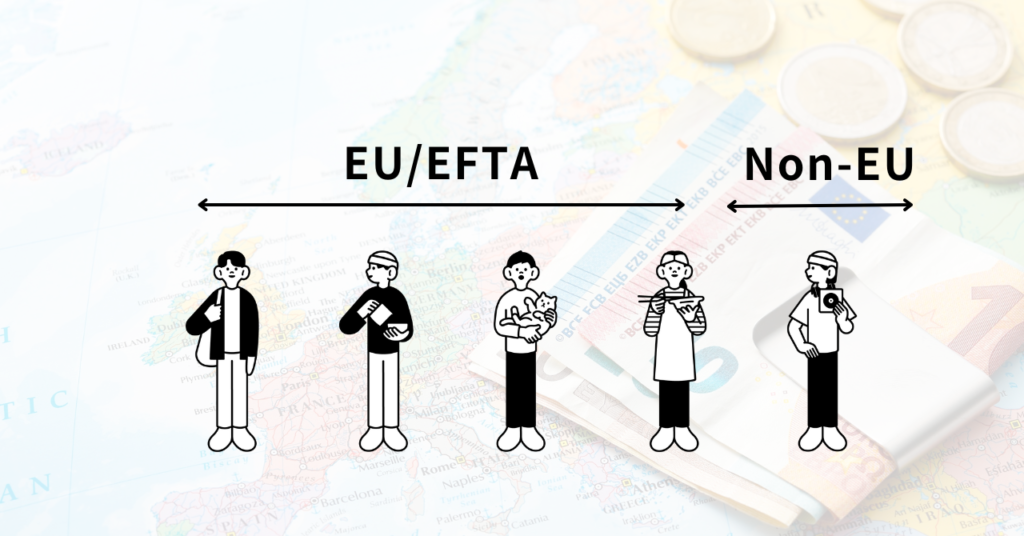
According to official statistics from the Swiss Federal Statistical Office:
- Switzerland employs approximately 1.88 million foreign workers³
- about 78.8% are EU/EFTA nationals³
- around 21.2% are non-EU nationals, corresponding to roughly 400,000 people³
This confirms that non-EU nationals are a minority in the Swiss labour market,
but they are clearly present within a tightly regulated system.
7. 🧠 Final Takeaway: Why Understanding the System Matters
Switzerland does hire non-EU nationals —
but only within a strict and selective legal framework.¹²
Understanding this framework allows you to:
- 🛑 stop blaming yourself for systemic rejections
- 🎯 interpret hiring outcomes correctly
- 🧭 approach job hunting more strategically
Most importantly, it helps you replace:
😞 “What is wrong with me?”
with:
💡 “How does the system work — and how can I work within it?”
8. 📚 References and Footnotes
¹ Swiss State Secretariat for Migration (SEM),
Admission of foreign workers.
https://www.sem.admin.ch/sem/en/home/themen/arbeit.html
² Federal Act on Foreign Nationals and Integration (FNIA),
Articles 18–23.
https://www.fedlex.admin.ch/eli/cc/2007/758/en
³ Working in Switzerland: visa, residence permit, and work permit
https://ggba.swiss/en/working-in-switzerland-visa-residence-permit-and-work-permit/